A Simpler, Stronger Architecture
Keystone consists of just three structural elements:
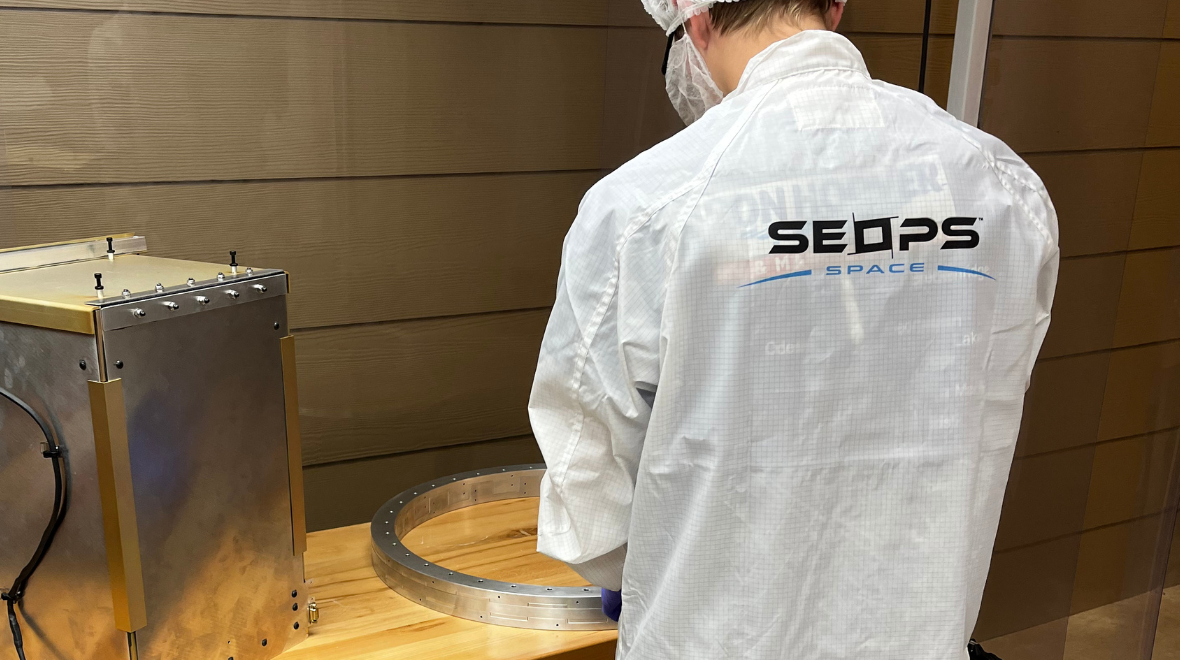
- Flyaway ring
- Compression band
- Stay-behind ring
By minimizing part count, we reduce potential points of failure and streamline inspection. The flat rings are CNC-machined from aerospace-grade aluminum alloy, chosen for its strength-to-weight ratio and resistance to deformation under load. Unlike thinner or more delicate rings, Keystone’s geometry resists torque and warping, making it suitable for payloads up to 850 kg.
While Keystone follows standard separation system guidelines, making it universally acceptable for the vast majority of spacecraft — and it was also designed specifically to meet SpaceX RPUG specs, including mass curves
The interface was engineered for cross-platform compatibility. While optimized for Falcon 9, Keystone can be readily adapted for multiple launch vehicles, providing operators with flexibility across rideshare opportunities.
Integration Efficiency
Where Keystone truly shifts the equation is during integration. The system attaches with standard mechanical fasteners—no external motors, actuators, or auxiliary connectors. Springs are housed internally within the ring, eliminating exposed components that are prone to damage or misalignment.
The result: integration timelines that are drastically reduced. With only bolts to torque down, teams can reliably complete mate operations in under an hour.
Reducing Cleanroom Risk
Integration remains one of the highest-risk phases for payloads. Traditional separation systems often require payloads to be lowered precisely into position while compressing external springs and aligning interfaces. For mass-asymmetric spacecraft, this process becomes tedious, requiring incremental adjustments to avoid misalignment. Small errors can lead to mechanical stress, compromised alignment, or, in worst cases, premature separation events during ground handling.
We’ve seen firsthand how fragile external mechanisms can fail under these conditions—snagged or bent springs, faulty switches, and even near-accidental deployments in the cleanroom.
Keystone eliminates these vulnerabilities. The rings naturally align, internalizing the springs and removing failure modes inherent to exposed hardware. By simplifying the mechanical interface, we drastically reduce the probability of integration incidents while improving repeatability and consistency.
“We have always been able to overcome spacecraft mate challenges, but it was at a cost in schedule, customer satisfaction, and money. With Keystone, I’m no longer concerned with the fragility and complexity of the separation system and what could go wrong but on accomplishing the operation correctly, safely, and efficiently for our customers.”
Engineering Value
Keystone offers:
- Reduced part count → fewer mechanical failure points
- Internalized springs → protected from damage and misalignment
- Cross-vehicle compatibility → one interface, multiple platforms
- Faster integration → ~1 hour, with no special tools or procedures
- Lower cost → priced below competing separation systems
Keystone is not just a new piece of hardware—it’s a systems-level solution to recurring integration challenges. For engineers tasked with ensuring payload safety and mission readiness, Keystone delivers what matters most: fewer failure modes, faster integration cycles, and a stronger mechanical backbone for deployment.
Integrate faster. Deploy safer. Lower cost. That’s Keystone.