Transporter-16 Spotlight: NearSpace Education 501c3 and NearSpace Launch Inc.

We’re getting close to launch day, and the excitement is building. As part of our largest integration effort yet, we’re highlighting some of the incredible payloads flying via SEOPS on the Transporter-16 mission. First up: NearSpace Launch (NSL) and NearSpace Education (NSE) from Upland, Indiana—one of our longtime customers and a familiar face on SEOPS missions.
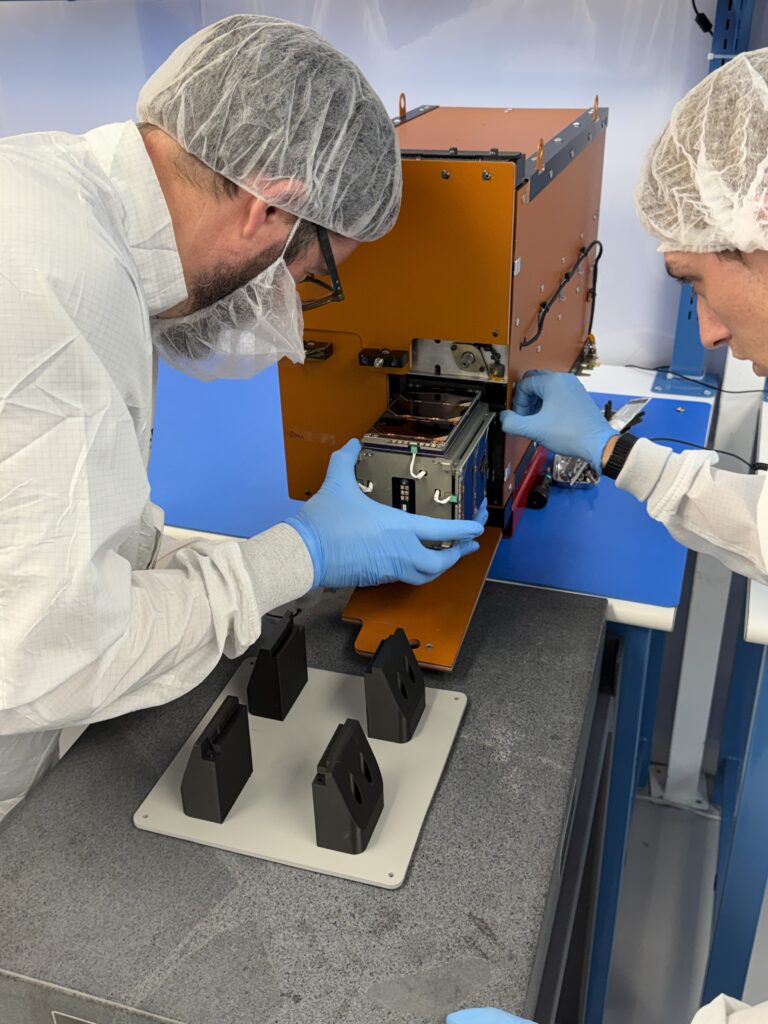
NearSpace Education 501c3, in partnership with NearSpace Launch Inc., is flying eight payloads across three education-focused missions, all of which are prepped for deployment in our Equalizer deployer hardware:
- The Dream Big Constellation, a six-satellite constellation built for 6 Midwest universities. The students delivered the payload within 12 months.
- AiglonSat-1, payload developed by students at Aiglon College in Switzerland
- TROOP-F3, The Train Rapid on Orbit Payload(TROOP) built by the NearSpace Launch as a hosted payload program for experimental missions.
Together, these missions reflect NSE’s core goal for the Dream Big Mission: inspiring students, equipping them with real technical skills, and preparing them for future challenges in aerospace and beyond. From advanced manufacturing to systems engineering and entrepreneurship, these payloads turn classroom lessons into real spaceflight experience.
Dream Big Constellation
The Dream Big Constellation is a standout example of student-driven innovation. Led by NearSpace Education (NSE), this project brings together students from six tri-state colleges, while also engaging 18 additional student groups across the region. The result is a six-satellite constellation designed to give students hands-on exposure to space systems, engineering, and scientific discovery.
Flying on a rideshare mission keeps costs down while still delivering real, on-orbit experience. Students are working with entry-level communications systems, remote sensing technologies, and mission concepts like system de-risking and cost reduction—skills that directly translate to real aerospace careers.
Once in orbit, the satellites will support communication tests and remote sensing activities, helping students see how space technology connects to everyday life. By lowering the barrier to entry, Dream Big makes space more accessible while empowering the next generation of engineers and scientists.
Here’s a closer look at each payload in the mission:
DB CHARMS ND
The Notre Dame IrishSat team is developing a magnetorquer-only ADCS (Attitude Determination and Control System). Designed to be low-power, modular, and scalable, this system offers a simplified solution for satellite detumbling and rough pointing—ideal for missions that need reliable control without complex sensor suites.
DB SkyForge CORE TU
Taylor University’s Physics and Engineering Department is flying a prototype of the SkyForge computational system—a key component of a space-walking robot designed to assemble large structures in orbit. Built with redundancy for reliability, this prototype marks a major milestone for student-led work in in-space construction and robotics.
DB BECON-2 VU
BECON-2, from Valparaiso University in Indiana, demonstrates crowd-sourced satellite downlinking using the SatNOGS network. Operating as a standalone satellite in a 0.5U ThinSat, the mission reduces spacecraft complexity and opens the door for less-experienced teams to generate meaningful scientific data. It also allows students and citizen scientists to directly participate in space missions.
DB-WALI-WMU
Built by the Western Aerospace Launch Initiative team at Western Michigan University in Kalamazoo Michigan, this payload focuses on designing and testing a Langmuir Probe to measure plasma ion density in Low Earth Orbit. The data could support future development of more efficient propulsion systems—an important step toward sustainable satellite operations and expanded smallsat missions.
DB-PFW
Students from Purdue-Fort Wayne’s College of Engineering, Technology, and Computer Science are tackling environmental challenges by detecting outliers in greenhouse gas emissions and monitoring aerosols like sand and dust. The goal is to provide affordable detection tools that can help communities prepare for environmental hazards, while also supporting emissions monitoring and decarbonization planning.
DB GME UT
Led by the University of Toledo, with support from local high schools, this payload focuses on remote sensing and environmental monitoring. The ThinSat will study land cover and surface temperature, with potential applications like tracking algae growth in Lake Erie—connecting satellite data directly to regional environmental issues.
AiglonSat-1
AiglonSat-1 is developed by a student team at Aiglon College in Switzerland and serves as both a technology demo and an educational platform. The CubeSat focuses on thermal behavior in small satellites, collecting data on how the spacecraft heats up in orbit.
That data will be shared with the broader engineering community to help future missions better manage thermal control challenges. Along the way, the project also supports STEM outreach and hands-on learning, building a bridge between classroom theory and real-world aerospace engineering.
TROOP-F3
Train Rapid On Payload (TROOP) is a hosted payload program launching on commercial launch providers every 6 to 9 months. Each TROOP offers four (4x) payload slots that allow customers quick and regular access to orbit. TROOP provides affordable and rapid turns on research iterations, a consistent opportunity to increase TRL numbers, and a variety of testing pathways for government, commercial, and research institutions.
We’re proud to support NearSpace Launch, NearSpace Education 501c3 and these inspiring student-led missions. From environmental monitoring to robotics and satellite systems, these payloads showcase what’s possible when education and spaceflight come together—and we can’t wait to see them fly.