Ready for Launch: Meet Some of the Spacecraft Flying on Transporter-17

Our team always enjoys launch campaigns, but there’s something particularly exciting about rideshare missions. They bring together a diverse mix of organizations, countries, technologies, and mission objectives—all sharing a ride to orbit aboard the same rocket.
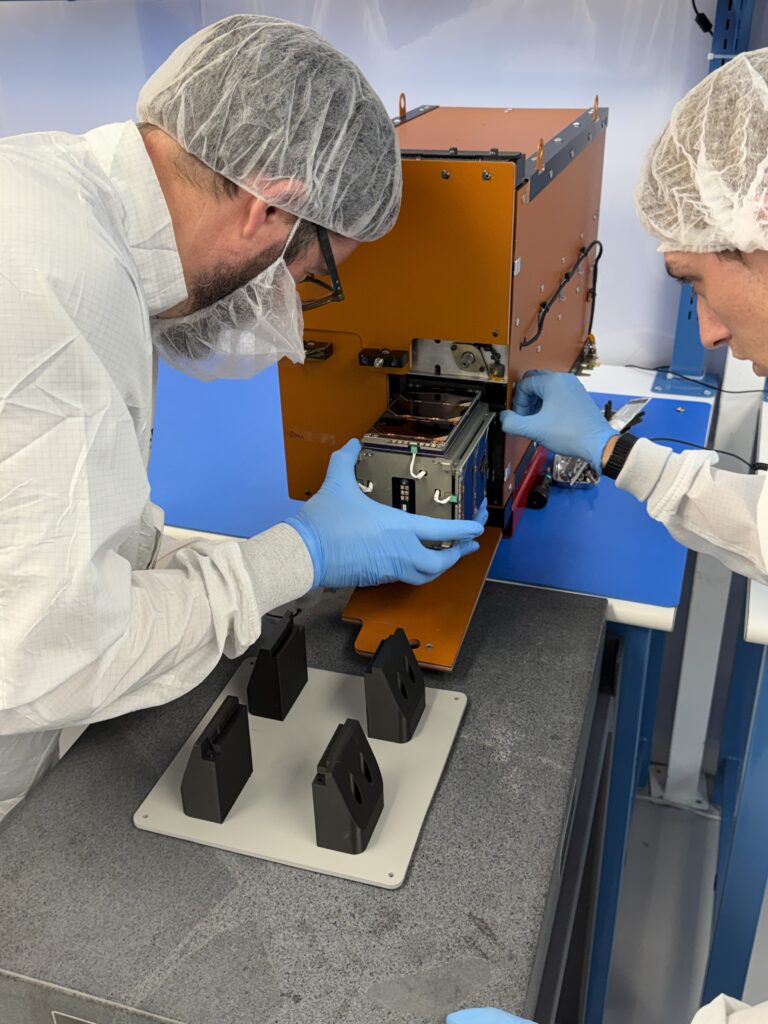
We’re happy to report that all 10 customer spacecraft SEOPS integrated are ready for flight on the Transporter-17 mission with SpaceX. The Falcon 9 launch is currently targeted for no earlier than July 2026 from Space Launch Complex 4E (SLC-4E) at Vandenberg Space Force Base in California.
This mission showcases exactly what makes rideshare so powerful: scientific research, university innovation, commercial communications, and national security technology demonstrations all heading to orbit together. Here’s a closer look at a few of the spacecraft we’ll be helping deliver to space.

–
GRITSS: Measuring Earth’s Geometry from Space
One of the most scientifically interesting spacecraft on the mission is GRITSS (Geodetic Reference Instrument Transponder for Small Satellites), a 12U CubeSat developed by ISISPACE in partnership with UMass Lowell and NASA.
While Earth may seem like a perfect sphere, scientists are continuously refining models of Earth’s geometry to better understand everything from sea level changes to shifts in the planet’s mass distribution. GRITSS carries a hosted payload designed to support research that improves the precision of those measurements.
It’s a great example of how relatively small spacecraft can contribute to major scientific discoveries and improve our understanding of the planet we call home.
–
MAVERIC: Students Building the Future of Space Operations
One of our favorite aspects of the small satellite industry is seeing students gain hands-on experience building real spacecraft that fly in orbit.
MAVERIC, developed by the University of Southern California’s Space Engineering Research Center, is designed to demonstrate advanced 2D and 3D visual imaging capabilities for future spacecraft-to-spacecraft interactions. The mission will also validate magnetometer performance using low-cost satellite hardware.
Perhaps most impressively, this is the fourth spacecraft developed by USC’s program and the first designed and built entirely by students as part of the university’s academic curriculum. For many of the students involved, this mission represents the culmination of years of engineering work and the beginning of careers in the space industry.

–
FOSSA-026: Expanding Global IoT Connectivity
Space is increasingly becoming part of everyday communications infrastructure, and FOSSA-026 is another step toward that future.
Developed by Spain-based FOSSA Systems, the spacecraft joins a growing constellation focused on secure RF communications and Internet of Things (IoT) connectivity. The launch marks the company’s 26th satellite deployed as part of its expanding network.
As industries around the world continue to rely on connected sensors and devices in remote locations, satellite-enabled IoT services are becoming an increasingly important part of the global communications ecosystem.

–
R5-S9: Rapid Innovation for Future Missions
R5 Spacecraft 9 (R5-S9) demonstrates how quickly spacecraft development is evolving.
Developed in partnership with Sandia National Laboratories, the mission hosts multiple technology payloads and showcases a rapid spacecraft development model. NASA and Sandia engineers worked together throughout integration and testing, helping prepare the spacecraft for launch.
Among the technologies onboard is a new low-cost optical communications system funded by NASA’s Space Technology Mission Directorate and developed by The Aerospace Corporation. Optical communications use light instead of traditional radio frequency transmissions, potentially enabling significantly higher data rates for future missions.
The spacecraft also highlights the growing trend toward rapid development cycles, taking approximately four months from design to delivery while incorporating improvements from previous R5 missions.

–
SPEAR-1: Advancing Technologies for National Security
The SPEAR-1 (Space Power and Energy Advanced Recon) mission represents an important effort to accelerate the transition of emerging space technologies from laboratory concepts to operational capabilities.
Developed by NearSpace Launch under a contract with the Department of Defense and Naval Research Laboratory, SPEAR-1 is designed to demonstrate and mature technologies that support future missions in power systems, communications, space situational awareness, and resilient satellite architectures.
The mission is part of a three-spacecraft constellation built using NearSpace Launch’s ThinSat® architecture, a platform designed to provide a rapid and cost-effective path for testing new technologies in orbit. By raising the Technology Readiness Level of critical systems, missions like SPEAR help ensure promising innovations can move more quickly from research into operational use.

–
One Mission, Many Futures
Transporter-17 highlights the incredible diversity of today’s space industry. On a single launch, scientific researchers are studying Earth’s geometry, students are demonstrating new imaging technologies, commercial operators are expanding communications networks, and government partners are advancing next-generation national security capabilities.
At SEOPS, we’re proud to support missions like these by helping customers navigate the path from spacecraft development to launch day. Every satellite has a different story, a different objective, and a different team behind it—but they all share the same goal: reaching orbit and delivering impact.
We look forward to seeing these spacecraft begin their journeys when Falcon 9 lifts off early this month.