Secure Now, Launch Later: Introducing LaunchLock
At SEOPS, we are proud to be opening a new frontier in responsive space access. For nearly a decade, we have been a trusted partner of both U.S. government and commercial customers to achieve mission success. As part of our relentless drive to serve our customers, we are committed to eliminating challenges, not just working through them.
One challenge many organizations face is securing a launch opportunity when spacecraft designs are not completely solidified. To help address this challenge, we have developed a flexible way to secure a launch: LaunchLock.
Booking a Launch When There Are Many Unknowns
Many organizations wanting to launch spacecraft deal with uncertain timelines. Trying to gauge spacecraft readiness, funding milestones, radio licensing, and supply chain logistics combined with buying launch capacity can be cumbersome. These challenges can be difficult, especially for first time flyers and those with unique spacecraft missions.
Typical launch contracts requiring operators to commit to a specific launch date in advance can be problematic and why it needs to be a launch window. Trying to align every milestone date sometimes feels like trying to get the planets to align and rebooking fees can start to pile up.
More Time, More Flexibility, More Assistance
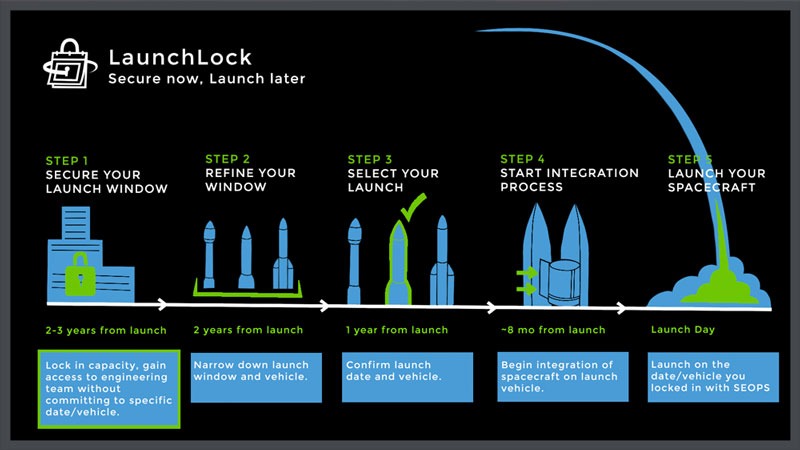
LaunchLock provides maximum flexibility with minimum risk because it focuses on a launch window that can be refined as you mature in the mission. It is designed for those who need more time, providing a 3-year advance opportunity to secure a launch window.
And possibly even more importantly for some, it provides early access and assistance from the SEOPS team to iron out requirements that may influence the spacecraft design. Early access to the integration team also means avoiding many of the pitfalls that come late in the game, and require costly waivers from launch vehicles, or more expensive modifications to meet criteria unknown at the beginning.
When you ‘lock in’ early, you can continue to prepare your spacecraft and obtain necessary licensing, funding, or other aspects core to the mission, while investors or customers have the reassurance that a launch has been secured to meet revenue targets or capability initiatives. As your launch window gets closer you will have the ability to narrow down a specific launch date.
Many organizations’ spacecraft missions are tied to longer term goals, and often lean ahead in the development of their spacecraft while anticipated subsystems and payloads are in various stages of flight qualification. This environment equates to an uncertain future regarding exact launch dates. LaunchLock lets organizations build flexibility into the complex planning process of launching a payload to the desired orbit, and is ideal for:
- Commercial Customers: Be confident that your launch is secured in the midst of uncertainty and ambiguity around development timelines, funding milestones and other moving targets. You’ll also lock in critical engineering knowledge and expertise earlier in the process, leading to a smoother ramp up to launch.
- Defense and Government: LaunchLock works for defense and government launch planning. With minimal details required at the start, it allows program managers and leaders to responsibly execute taxpayer dollars and ensure launch capacity is covered in a way that doesn’t jeopardize mission execution timelines.
- Research and Education: Researchers frequently have funding constraints and are often forced to wait and address their launch needs very late in the process. LaunchLock permits institutions and organizations to secure launch capacity as one of the first steps without knowing all the details of time and logistics. This approach bolsters proposal efforts for grants and various opportunities.
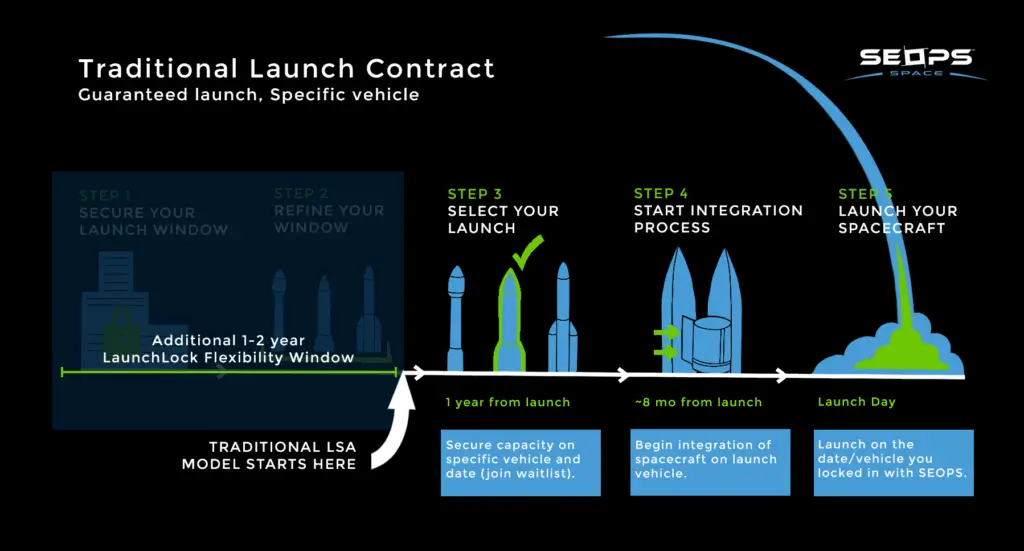
For those who have confidence in spacecraft readiness and know the launch vehicle and date they want to fly, SEOPS provides traditional Launch Service Agreements (LSAs). When signing the LSA about 12 months from the desired launch, a customer selects a specific vehicle and launch date. While efficient and streamlined, these contracts are less flexible, often having financial penalties and added operational consequences in the event rebooking is necessary for changes or delays.
Whether you need a traditional LSA or the added flexibility of LaunchLock, SEOPS is your trusted expert to get you where you need to go. SEOPS will continue to derive innovative and flexible solutions to serve our customers.
If you are interested in discussing which options are right for you, drop us a line at [email protected].